At Long Last
Joshua 16:4 is one of those verses that looks small until you stop and listen to it: “So the children of Joseph, Manasseh and Ephraim, took their inheritance.” In plain language, it is a brief record of land received. In spiritual weight, it is the sigh of centuries. It is the breath that finally leaves the chest when God has done what He said He would do.
A few years ago, on a mission trip to Ghana, West Africa, with my father, I picked up on the phrase “at long last.” It stayed with me. In Ghana, that expression carries unusual force because it is forever linked with Kwame Nkrumah’s declaration at independence on March 6, 1957: “At long last, the battle has ended!” It was the language of struggle finally breaking open into release. It was not casual language. It was the sound of pressure giving way.
That is exactly what is sitting inside Joshua 16:4. This is not just an inheritance taken. This is a battle ended. This is a promise no longer postponed. This is a word from God, carried through tears and trials and generations, at last standing up in visible form.
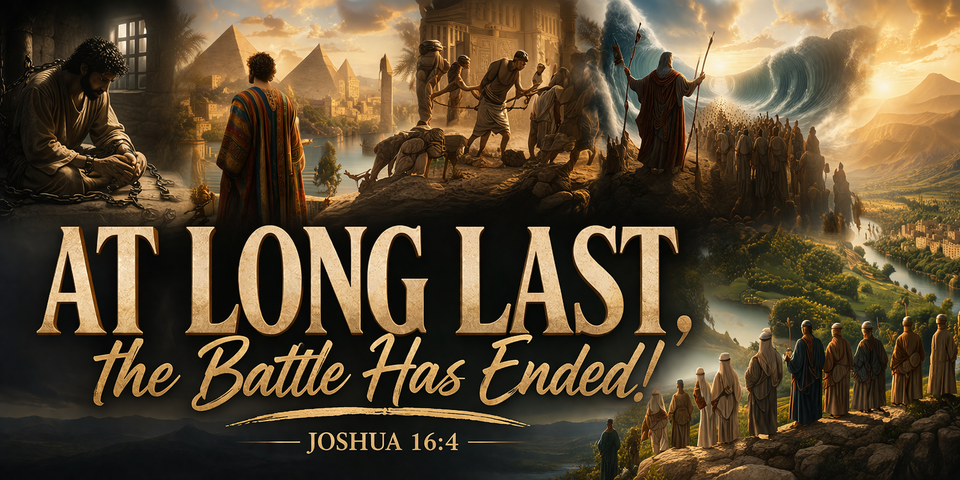
And look carefully at the names in the verse: Joseph, Manasseh, and Ephraim. The Holy Ghost did not merely say that some tribes got land. He pointed us back to Joseph. That matters. Because when you say Joseph, you are calling up one of the longest roads in all the Bible. You are calling up dreams, betrayal, a pit, slavery, false accusation, prison, waiting, promotion, famine, preservation, and a family brought down into Egypt under the overruling hand of God. Joshua 16:4 is not merely the end of wilderness wandering. It is the far echo of Joseph’s tears.
And in truth, it reaches back even farther than Joseph. The deeper root of this moment is the word God gave to Abraham. The Lord said, “Know of a surety that thy seed shall be a stranger in a land that is not theirs, and shall serve them; and they shall afflict them four hundred years.” Yet in the same breath God also declared that afterward they would come out, and that He would give them the land. So by the time Joshua 16:4 arrives, we are not looking at a short-term answer. We are looking at a centuries-old promise coming to rest on schedule, exactly as God intended.
That is why this verse feels so deep. Joseph never personally lived to see Joshua divide Canaan. Abraham never stood in Joshua 16 and watched Manasseh and Ephraim take possession. Whole generations died with the promise still in front of them. Yet the word of God kept moving. It moved through the pit. It moved through Egypt. It moved through affliction. It moved through the Exodus. It moved through the wilderness. It moved through Jordan. It moved through war. And at long last, it arrived.
That is one of the great glories of the word of God: time does not weaken it. Delay does not dilute it. Death does not bury it. The promise may outlive the man who first heard it, but it will not fail. God can speak a word in one generation and fulfill it in another, and there is no erosion in His faithfulness between the speaking and the performing. Joshua 16:4 is a monument to the endurance of divine promise.
And then there is Manasseh and Ephraim. These are Joseph’s sons, born in Egypt, raised in a foreign land, yet folded by Jacob into the covenant line and inheritance purpose of God. That alone will preach. What was born in exile was not excluded from promise. What came forth in a strange place was still claimed by the purposes of God. Egypt did not have the power to cancel what heaven had spoken. The place of delay could not destroy the place of destiny.
That makes Joshua 16:4 even sweeter. These are not random names in a tribal list. These names are proof that God remembers His word across bloodlines, borders, hardships, and centuries. Joseph’s affliction was not wasted. Manasseh’s foreign birth was not disqualifying. Ephraim’s line was not forgotten. The covenant kept traveling. The promise kept breathing. The word kept standing. And now, at long last, they took their inheritance.
That is why Proverbs 13:12 fits here so perfectly: “Hope deferred maketh the heart sick: but when the desire cometh, it is a tree of life.” This is not the language of mild inconvenience. Hope deferred is not a small thing. It makes the heart sick. Long waiting has weight to it. Long battles leave their mark. Long delays stretch the soul. But then comes that moment when the desire cometh, and what had been sickness gives way to life. Joshua 16:4 is one of those tree-of-life moments in Scripture.
And surely this was their morning of joy. Psalm 30:5 says, “Weeping may endure for a night, but joy cometh in the morning.” There had been a long night behind this verse. The night of slavery. The night of wandering. The night of funerals in the wilderness. The night of warfare in the land. But morning came. Joshua 16:4 stands there like sunrise over a promise that had survived every darkness sent against it.
And Job’s language belongs here too. Job 14:9 says, “Yet through the scent of water it will bud, and bring forth boughs like a plant.” There are times in life when all you have is the scent of water, only a faint indication that God is not finished yet. Only a hint that life may rise again. Only enough mercy to keep you from giving up. But Joshua 16:4 is even stronger than the scent of water. This is not the first hint of restoration. This is realized promise. This is the bud opened. This is the branch full. This is faith becoming sight.
And now add Ebenezer to the picture. 1 Samuel 7:12 says, “Then Samuel took a stone, and set it between Mizpeh and Shen, and called the name of it Ebenezer, saying, Hitherto hath the Lord helped us.” That is the spirit that hovers over Joshua 16:4. When Manasseh and Ephraim took their inheritance, it was as though another stone could have been raised in the land and written over with the same testimony: Hitherto hath the Lord helped us. Through Joseph’s pit, hitherto hath the Lord helped us. Through Egypt, hitherto hath the Lord helped us. Through affliction, hitherto hath the Lord helped us. Through Pharaoh, through the sea, through the wilderness, through Jordan, through Jericho, through every enemy and every delay, hitherto hath the Lord helped us.
That is what makes “at long last” such a fitting title for this moment. It is not merely the joy of getting something wanted. It is the relief of seeing that God has been faithful all along. It is the realization that every hard mile had not been empty. It is the discovery that even when fulfillment was delayed, the hand of God was still advancing His word. “At long last” is not just the cry of arrival. It is the confession that the Lord has carried His people all the way to the place He promised.
So when I read, “So the children of Joseph, Manasseh and Ephraim, took their inheritance,” I do not hear a cold record. I hear the end of a battle. I hear the settling of a centuries-old word. I hear the release of long-held breath. I hear weary saints looking over the landscape of fulfilled promise and saying, at long last.
And maybe that is where some soul is living right now, somewhere between promise given and promise possessed. Somewhere between Joseph’s dreams and Joshua’s division of the land. Somewhere between the first word and the final fulfillment. If so, this verse reminds us that God does not lose track of what He said. His promises do not expire while we wait. His faithfulness does not thin out over time. The road may be long, but the word is longer. The battle may be fierce, but the promise is stronger.
Joshua 16:4 is an inheritance verse, yes. But it is also a memorial verse. It is an Ebenezer verse. It is a dawn-after-darkness verse. It is a tree-of-life-after-sickness verse. It is a scent-of-water-turned-river verse. It is the kind of verse that teaches us that when God speaks, He means to finish what He started.
At long last, the waiting broke.
At long last, the battle ended.
At long last, Joseph’s line stood in what God had spoken.
At long last, hope gave way to sight.
At long last, the proper testimony could be written over it all:
1 Samuel 7:12 “Hitherto hath the Lord helped us.”
~ Pastor Gary Caudill
A few years ago, on a mission trip to Ghana, West Africa, with my father, I picked up on the phrase “at long last.” It stayed with me. In Ghana, that expression carries unusual force because it is forever linked with Kwame Nkrumah’s declaration at independence on March 6, 1957: “At long last, the battle has ended!” It was the language of struggle finally breaking open into release. It was not casual language. It was the sound of pressure giving way.
That is exactly what is sitting inside Joshua 16:4. This is not just an inheritance taken. This is a battle ended. This is a promise no longer postponed. This is a word from God, carried through tears and trials and generations, at last standing up in visible form.
And look carefully at the names in the verse: Joseph, Manasseh, and Ephraim. The Holy Ghost did not merely say that some tribes got land. He pointed us back to Joseph. That matters. Because when you say Joseph, you are calling up one of the longest roads in all the Bible. You are calling up dreams, betrayal, a pit, slavery, false accusation, prison, waiting, promotion, famine, preservation, and a family brought down into Egypt under the overruling hand of God. Joshua 16:4 is not merely the end of wilderness wandering. It is the far echo of Joseph’s tears.
And in truth, it reaches back even farther than Joseph. The deeper root of this moment is the word God gave to Abraham. The Lord said, “Know of a surety that thy seed shall be a stranger in a land that is not theirs, and shall serve them; and they shall afflict them four hundred years.” Yet in the same breath God also declared that afterward they would come out, and that He would give them the land. So by the time Joshua 16:4 arrives, we are not looking at a short-term answer. We are looking at a centuries-old promise coming to rest on schedule, exactly as God intended.
That is why this verse feels so deep. Joseph never personally lived to see Joshua divide Canaan. Abraham never stood in Joshua 16 and watched Manasseh and Ephraim take possession. Whole generations died with the promise still in front of them. Yet the word of God kept moving. It moved through the pit. It moved through Egypt. It moved through affliction. It moved through the Exodus. It moved through the wilderness. It moved through Jordan. It moved through war. And at long last, it arrived.
That is one of the great glories of the word of God: time does not weaken it. Delay does not dilute it. Death does not bury it. The promise may outlive the man who first heard it, but it will not fail. God can speak a word in one generation and fulfill it in another, and there is no erosion in His faithfulness between the speaking and the performing. Joshua 16:4 is a monument to the endurance of divine promise.
And then there is Manasseh and Ephraim. These are Joseph’s sons, born in Egypt, raised in a foreign land, yet folded by Jacob into the covenant line and inheritance purpose of God. That alone will preach. What was born in exile was not excluded from promise. What came forth in a strange place was still claimed by the purposes of God. Egypt did not have the power to cancel what heaven had spoken. The place of delay could not destroy the place of destiny.
That makes Joshua 16:4 even sweeter. These are not random names in a tribal list. These names are proof that God remembers His word across bloodlines, borders, hardships, and centuries. Joseph’s affliction was not wasted. Manasseh’s foreign birth was not disqualifying. Ephraim’s line was not forgotten. The covenant kept traveling. The promise kept breathing. The word kept standing. And now, at long last, they took their inheritance.
That is why Proverbs 13:12 fits here so perfectly: “Hope deferred maketh the heart sick: but when the desire cometh, it is a tree of life.” This is not the language of mild inconvenience. Hope deferred is not a small thing. It makes the heart sick. Long waiting has weight to it. Long battles leave their mark. Long delays stretch the soul. But then comes that moment when the desire cometh, and what had been sickness gives way to life. Joshua 16:4 is one of those tree-of-life moments in Scripture.
And surely this was their morning of joy. Psalm 30:5 says, “Weeping may endure for a night, but joy cometh in the morning.” There had been a long night behind this verse. The night of slavery. The night of wandering. The night of funerals in the wilderness. The night of warfare in the land. But morning came. Joshua 16:4 stands there like sunrise over a promise that had survived every darkness sent against it.
And Job’s language belongs here too. Job 14:9 says, “Yet through the scent of water it will bud, and bring forth boughs like a plant.” There are times in life when all you have is the scent of water, only a faint indication that God is not finished yet. Only a hint that life may rise again. Only enough mercy to keep you from giving up. But Joshua 16:4 is even stronger than the scent of water. This is not the first hint of restoration. This is realized promise. This is the bud opened. This is the branch full. This is faith becoming sight.
And now add Ebenezer to the picture. 1 Samuel 7:12 says, “Then Samuel took a stone, and set it between Mizpeh and Shen, and called the name of it Ebenezer, saying, Hitherto hath the Lord helped us.” That is the spirit that hovers over Joshua 16:4. When Manasseh and Ephraim took their inheritance, it was as though another stone could have been raised in the land and written over with the same testimony: Hitherto hath the Lord helped us. Through Joseph’s pit, hitherto hath the Lord helped us. Through Egypt, hitherto hath the Lord helped us. Through affliction, hitherto hath the Lord helped us. Through Pharaoh, through the sea, through the wilderness, through Jordan, through Jericho, through every enemy and every delay, hitherto hath the Lord helped us.
That is what makes “at long last” such a fitting title for this moment. It is not merely the joy of getting something wanted. It is the relief of seeing that God has been faithful all along. It is the realization that every hard mile had not been empty. It is the discovery that even when fulfillment was delayed, the hand of God was still advancing His word. “At long last” is not just the cry of arrival. It is the confession that the Lord has carried His people all the way to the place He promised.
So when I read, “So the children of Joseph, Manasseh and Ephraim, took their inheritance,” I do not hear a cold record. I hear the end of a battle. I hear the settling of a centuries-old word. I hear the release of long-held breath. I hear weary saints looking over the landscape of fulfilled promise and saying, at long last.
And maybe that is where some soul is living right now, somewhere between promise given and promise possessed. Somewhere between Joseph’s dreams and Joshua’s division of the land. Somewhere between the first word and the final fulfillment. If so, this verse reminds us that God does not lose track of what He said. His promises do not expire while we wait. His faithfulness does not thin out over time. The road may be long, but the word is longer. The battle may be fierce, but the promise is stronger.
Joshua 16:4 is an inheritance verse, yes. But it is also a memorial verse. It is an Ebenezer verse. It is a dawn-after-darkness verse. It is a tree-of-life-after-sickness verse. It is a scent-of-water-turned-river verse. It is the kind of verse that teaches us that when God speaks, He means to finish what He started.
At long last, the waiting broke.
At long last, the battle ended.
At long last, Joseph’s line stood in what God had spoken.
At long last, hope gave way to sight.
At long last, the proper testimony could be written over it all:
1 Samuel 7:12 “Hitherto hath the Lord helped us.”
~ Pastor Gary Caudill